The Equipment

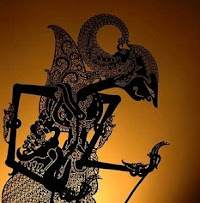
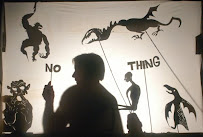
The equipment needed for a wayang performance includes a screen, a lamp , a base into which the puppets can be stuck so that they stand upright, a large wooden chest, knockers, rattles and a set of gamelan instruments for the orchestra.
Posted on 04.44 by Lordly Shades and filed under | 0 Comments »

The Screen


The screen, or "kelir", is made of white cotton with borders all round it, usually red, but sometimes blue, black, green or even patterned. The border at the bottom, which represents the ground or floor of the “stage”, is 8 to 10 centimeters wide, while the side and top borders are a little wider. Sometimes, there is an ornate but sturdy wooden frame for the screen, decorated with fret – work and serpents running across the top. This frame is equipped with hooks to which the screen is tied and it is also provided with an attachment for the lamp.

Not all of the screen is used for the action. Clearly, the dalang, seated cross-legged in front of the screen, could not manipulate the puppets over so wide an expense. An area in the centre of the screen, about 1.6 meters wide, is left vacant for “ the stage “, whilst puppets not in use are stood up in a row to right and left, with the “good” characters on the dalang’s right and the “bad” ones on his left . The puppets to be used in the play are either placed in the wooden chest on his left or, on the dalang’s right-hand side, in the lid of the chest.
Posted on 04.40 by Lordly Shades and filed under | 0 Comments »

The Lamp


Traditionally, the lamp used for a Wayang Purwa performance burnt coconut oil with a cotton-like wick floating in it, similar in style to oil-lamps known the whole world over in ancient times. But the lamp itself, the container for the oil, or blenchong as it called, is nothing but Indonesian. It takes the form of the mythical Garuda eagle, made of bronze or brass; it has a crowned head, the wings are spread in flight and the tail is raised, so that the light from the wick, which usually issues from the Garuda’s open beak, is all thrown forward onto the screen.

Since the performance lasts for around 9 hours, the oil in the blencong has to be replenished several times, while the wick must be trimmed and lengthened. This is an additional task for the dalang, for the lamp is approximately above his head.

These are good enough reasons for switching to electric lighting, which is also more powerful. But, if the shadows are therefore more distinct, so that they can be seen from a greater distance by a larger audience, the quality of the shadows is changed. The depth of shadows is constant and the shadows no longer flicker, so that some of the mystery and some of the artistic quality is lost from the shadow side of the screen. In contras, however, from the dalang’s side of the screen, where increasing numbers of people prefer to sit today, the coloring of the puppets appears brighter. In the case of the rare performances given with puppets encrusted with jewels, of course this splendor flashes all the brighter under an electric light.
Posted on 04.38 by Lordly Shades and filed under | 0 Comments »

The Banana Bole


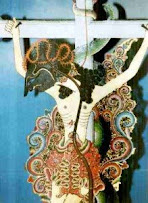
The all-important base for the puppets during a performance, the "dhebog", is composed of the trunks, or boles, of three banana trees. The banana is not really a tree; its “trunk” is formed of the bases of leaf stalks, one inside the other, making a strong sheath, from which the flower-head rises. And so this bole makes a firm, but easily pierced, base into which the horn handles of the puppets can be stabbed. Moreover, the banana bole will not wilt for a week or so.

Two such boles are placed end to end at the base of the screen, with the third one set in the middle, at a lower level than the others. When the puppets are stuck into the lower bole, than their legs end feet are not visible through the border, and so they appear to be seated on the floor. Lesser characters or those of lower rank in particular scene can thus be shown to have an inferior status in the play.

The boles are supported on wooden stand and the two top ones are affixed to the bottom of the screen.
Posted on 04.33 by Lordly Shades and filed under | 0 Comments »

The Wooden Chest


The kotak is a large wooden chest with a removable lid, which forms a tray on its own. All the wayang puppets are kept in this chest, together with other equipment such us the screen. To store a complete set of puppets, the chest should be about 1.5 meters, 75 centimeters wide and about 60 centimeters deep with the lid on. To keep the wayang puppets flat and to prevent their movable arm becoming entangled, the puppets are often put first, about thirty at a time, into large portfolios, or placed between two sheets of thick card strung together.

During a performance, the lid is taken off the chest and placed on the dalang’s right, where it acts as a shallow tray for puppets awaiting their turn to appear “on stage”. The opened chest is placed close to the dalang on his left-hand side. Even though most puppets have been lined up on either side of the “stage”, standing in the banana boles, the chest contains still more puppets. The chest also act as a sound-box for the knocking and rattling sound made by the chempala and kepyak.
Posted on 04.32 by Lordly Shades and filed under | 0 Comments »

Knockers and Rattles


The Two knockers, or chempala, are usually made of teak wood, more or less hammer-shaped. The larger one is about 20 centimeters long with a head 5 centimeter across, while the smaller chempala is about half the size. These instruments are used to knock the wooden chest either for sound effects, or else to give the dalang’s coded signal to the musicians. The larger chempala is held in the dalang’s left hand and is knocked against the inside of the chest. The smaller one is used when both hands are busy with the puppets, when it is held between the big toe and the second toe of the dalang’s right foot and is knocked against the outside of the chest. Since the dalang sits cross-legged with his right foot on his left thigh, his right foot is close to the wooden chest.

The rattles, or kepyak, are usually made of three small bronze plates measuring about 15 by 10 centimeters, which are strung together above one another so that they overlap loosely; they are attached to the side of the wooden chest during a performance. The kepyak are struck either with the toes of the dalang’s right foot, or else with the small knocker, and the plates then clatter against one another.

The knocking and rattling noises produced by these instruments, punctuating events or accentuating the action of a performance, are a characteristic of Wayang Purwa shows, and pierce the night for considerable distance.
Posted on 04.20 by Lordly Shades and filed under | 0 Comments »

The Gamelan Orchestra


Another sound that carries very far on the night air is the music of the gamelan, that of the big gongs in particular.

There are usually 15 different types of instrument in a modern gamelan orchestra. There are various kinds of metal gongs and xylophones, some of them slung over sound boxes; there are double-ended horizontal drums on wooden stand; there is a wooden xylophone, a bamboo flute called a suling, and a two-stringed bowed lute, the rebab. The gamelan orchestra is thus composed mainly of percussion instruments.

The instruments of this orchestra are arranged in a traditional pattern behind the dalang in a wayang performance. It has already been noted that the drummer is the leading player, who passes on the coded signals about music to the rest of the orchestra; he sits close enough to the dalang, usually at the centre of the gamelan orchestra.

This means that there is a distance of about 5 meters from the screen to the far edge of the orchestra arrangement. So if the audience wishes to sit on the dalang’s side of the screen, it cannot sit very close to him. In contrast, the audience sitting on the shadow side need be no further away than is necessary to take in the extent of the “stage” at a glance. If an audience is to sit on both sides of the screen, then a considerable length must be allowed when planning the performance. Quite often, a performance is planned for an audience on only one side, and this is more often the dalang’s side of the screen today.
Posted on 04.14 by Lordly Shades and filed under | 0 Comments »

Dramatis Personae


The dramatis personae of a Wayang Purwa performance are very diverse. They consist of the dalang, who is the leading artist, the niyaga, or musicians , and the pesinden, who are the woman singers. To this brief list, the wayang, the puppets themselves, can be added; from one point of view, the puppets are the real actors and actresses, even if, from another, they are but inanimate objects.

The dalang is, in fact, a most extraordinary artist. He is the key to the entire performance. A good dalang guarantees that even the most meager facilities will produce a sparkling performance with beautiful singing, excellent dialogue with a delicate literary appreciation and a nice distinction between the different grades of classical Javanese that mark social rank.

Classical Javanese is the language par excellence of Wayang Purwa, being the language in which it developed. Today, however performances are sometimes given in the national language, Indonesian, and even occasionally in English, which is the Republic’s first foreign language.

The dalang is the sole puppeteer and is the director of the entire performance, signaling to the musicians who sit behind him what to play, how to play and when to stop. The dalang “speaks” for all the puppets he uses, changing his voice and style of speaking to suit the different characters, even singing in these different voices. To quality, a dalang must be able to speak in at least 30 voices, so as to be able to play the characters of the puppets he uses. The dalang also declaims and narrates and he sings the songs called suluk, which express the mood of a given scene. He also groans, grunts, cries and shrieks in fighting sequences.

As he manipulates the puppets, the dalang makes them move and act in ways that conform with their traditional characters: gently, vigorously, aggressively, and som forth. In addition the dalang wields the wooden knockers and metal rattles that add dramatic co lour to the performance and with which he signal to the musicians. Since both his hands are often busy moving the puppets, the dalang may use his right foot to operate the knocker and rattles, making them resound against the wooden chest in which the puppets are kept. The chest is placed close beside the dalang, on his left, during a performance. In most performance today, the dalang has a helper whose function is no more than to find and hand the wayang to the dalang.

The dalang’s role occupies him for about 9 hours at a time, seated cross legged before the screen, unable to leave his mat even for a minute. A dalang must also master a considerable repertoire; it is not just one or two plays that he will know by heart, but perhaps as many as 30 or 40, or even more. Approximately thirty per cent of the content of the plays is entirely bound by tradition in both word and tone. The dalang must also be ready to slip in at the appropriate places the comments on the current situation that he hears among the people, and to add amusing details that enlighten listeners about, say, the drive for better nutrition or family planning. This is how the dalang serves as an instrument of two way communication between people and government.

The skill of the dalang, which is best displayed by his knowledge of the Javanese classics, used to be an oral tradition, handed down from father to son. For the last 60 years, however, people have been able to learn this art outside the family circle. A school for dalang was set up in the court city of Surakarta, which is also known as Solo, in 1923. Nevertheless, there are still people who learn the dalang’s art in the traditional manner, at least as a beginning.

Today, a number of women have also learnt the arts of the dalang. Among the several dozen women dalangs of today, some have won a respected position. Their numbers are still insignificant, however by comparison with an estimated total of 20,000 male dalangs. This figure includes not a few teenagers, with here and there a skilled boy amongst them.

The great majority of all these dalangs are accustomed to the puppets used for Wayang Purwa. Some are skilled with Wayang Golek, but, for a number of other kinds of wayang, such as Wayang Beber, for instance, there are only one or two, or even no dalangs alive at all, to give a performance today.
Posted on 04.54 by Lordly Shades and filed under | 0 Comments »

The Niyaga


There are usually 13 of these musicians, who are sometimes called “Wiyaga”, to accompany a Wayang Purwa performance. They play at least 15 different kinds of instruments, and so a few of them play to instruments in different parts of the performance. At times, some or all of them sing, or clap in very sophisticated rhythms, perhaps while the pesinden are singing.

The most important musician is the drummer, who passes on to the rest of the orchestra the coded signal given by the dalang as to what or how to play. In other words, the other musicians follow the lead given by the drummer.

Like the knockers and rattles manipulated by the dalang, the sound of the drum also accentuates dramatic passages in the play.

The musicians sit cross legged on the floor before their instruments and behind the dalang.
Posted on 04.37 by Lordly Shades and filed under | 0 Comments »