The Wayang Purwa Stories

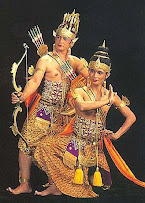
The Ramayana is essentially a love story, the story of Lord Rama’s search for his beautiful wife, Sinta.

Dasarata, King of Ayodya, had to fulfil a promise to one of his wives and let her son Barata ascend the throne, even though it meant exile to the forest for a son by another wife, his beloved Rama.

Rama, an incarnation of Batara Wisnu, knew that his love and happiness with Sinta was but the prelude to long suffering to enable him to accomplish the duty of Wisnu. Barata, who did not want to see Rama ousted, was therefore unable to persuade Rama to return to Ayodya. And Rama, followed by the faithful Sinta and Laksmana, his inseparable companion and another half-brother, went away and lived in the forest.

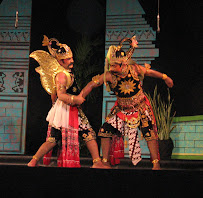
They were overtaken by disaster due to Sinta’s over-powering desire for possession of a golden deer seen in the forest. But the deer in reality was sent by the ten-headed demon Rahwana, symbol of man’s lusts. Having tricked both Rama and Laksmana, Rahwana abducted Sinta and bore her off to the island of Alengka. Jatayu, king of the birds, intercepted Rahwana, but was mortally wounded and lived only long enough to tell Rama about Sinta’s abduction.

At long last, the white ape Hanoman discovered where Sinta was hid in the island kingdom. An army of monkeys, led by Sugriwa, built a causeway to Alengka, crossed over, and helped to kill Rahwana. Rama and Sinta were united once more.

But Rama listened to voice doubting Sinta’s purity after so long a captivity. Sinta had to undergo a trial by fire and was saved by Agni, Goddess of Fire, who convinced Rama of Sinta’s purity.
Posted on 12.51 by Lordly Shades and filed under | 3 Comments »

Performance


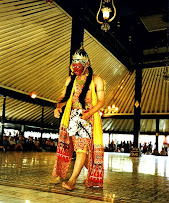
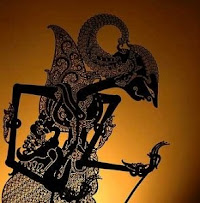
A Wayang Purwa performance is a complicated compound of very diverse elements. It is a shadow-show and a puppet play requiring the greatest possible dexterity on the part of the dalang, particularly in the fighting scenes. It is a recital of both classical and modern Javanese music, both vocal and orchestral. Further, a number of classical prose poems, known and loved by the Javanese public and composed of the most beautiful language, are declaimed to soft music by the dalang. The performance is enlivened by clowning, often ad lib; and usually some slap-stick. It also contains comment on current affairs, local, national, and even international. In addition to all of which, the point of the entire performance is ethical education and character-building.

The “Eleven-Eleven” system is a good way of describing how all these elements fit together in a performance.

The first “Eleven” is composed of the dramatis personae and the equipment already described above. The second “Eleven” enumerates the audio-visual effects obtained in action. All of the first “Eleven” are visible only from the dalang’s side of the screen, but the second “Eleven” can be better enjoyed from the shadow side.

The two sides of the system are listed as follows hereunder:

Dramatis Personae And Equipment

1 Dalang – The leading artist
2 Niyaga – Musicians
3 Pesinden – Women Singers
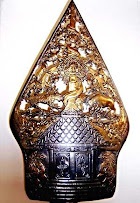
4 Wayang – Puppet
5 Kelir - Screen
6 Blencong – Oil Lamp
7 Dhebog – Banana Boles
8 Kotak – Wooden Chest
9 Chempala – Wooden Knocker
10 Kepyak – Metal Rattles
11 Gamelan – Orchestra instruments

Audio-Visual effect

1 Sabetan – Puppet Movements
2 Janturan – Declaimed narration
3 Chariyos – Narration
4 Ginem – Dialogue
5 Suluk – Mood-setting songs
6 Tembang – Songs
7 Dodogan – Knocking sounds on wood
8 Kepyakan – Mettalic Rattling
9 Gending – Melodies
10 Gerong Male Chorus
11 Sindenan – Songs by the pesinden


Posted on 02.00 by Lordly Shades and filed under | 3 Comments »

The Equipment

The equipment needed for a wayang performance includes a screen, a lamp , a base into which the puppets can be stuck so that they stand upright, a large wooden chest, knockers, rattles and a set of gamelan instruments for the orchestra.
Posted on 04.44 by Lordly Shades and filed under | 0 Comments »

The Screen


The screen, or "kelir", is made of white cotton with borders all round it, usually red, but sometimes blue, black, green or even patterned. The border at the bottom, which represents the ground or floor of the “stage”, is 8 to 10 centimeters wide, while the side and top borders are a little wider. Sometimes, there is an ornate but sturdy wooden frame for the screen, decorated with fret – work and serpents running across the top. This frame is equipped with hooks to which the screen is tied and it is also provided with an attachment for the lamp.

Not all of the screen is used for the action. Clearly, the dalang, seated cross-legged in front of the screen, could not manipulate the puppets over so wide an expense. An area in the centre of the screen, about 1.6 meters wide, is left vacant for “ the stage “, whilst puppets not in use are stood up in a row to right and left, with the “good” characters on the dalang’s right and the “bad” ones on his left . The puppets to be used in the play are either placed in the wooden chest on his left or, on the dalang’s right-hand side, in the lid of the chest.
Posted on 04.40 by Lordly Shades and filed under | 0 Comments »

The Lamp


Traditionally, the lamp used for a Wayang Purwa performance burnt coconut oil with a cotton-like wick floating in it, similar in style to oil-lamps known the whole world over in ancient times. But the lamp itself, the container for the oil, or blenchong as it called, is nothing but Indonesian. It takes the form of the mythical Garuda eagle, made of bronze or brass; it has a crowned head, the wings are spread in flight and the tail is raised, so that the light from the wick, which usually issues from the Garuda’s open beak, is all thrown forward onto the screen.

Since the performance lasts for around 9 hours, the oil in the blencong has to be replenished several times, while the wick must be trimmed and lengthened. This is an additional task for the dalang, for the lamp is approximately above his head.

These are good enough reasons for switching to electric lighting, which is also more powerful. But, if the shadows are therefore more distinct, so that they can be seen from a greater distance by a larger audience, the quality of the shadows is changed. The depth of shadows is constant and the shadows no longer flicker, so that some of the mystery and some of the artistic quality is lost from the shadow side of the screen. In contras, however, from the dalang’s side of the screen, where increasing numbers of people prefer to sit today, the coloring of the puppets appears brighter. In the case of the rare performances given with puppets encrusted with jewels, of course this splendor flashes all the brighter under an electric light.
Posted on 04.38 by Lordly Shades and filed under | 0 Comments »

The Banana Bole


The all-important base for the puppets during a performance, the "dhebog", is composed of the trunks, or boles, of three banana trees. The banana is not really a tree; its “trunk” is formed of the bases of leaf stalks, one inside the other, making a strong sheath, from which the flower-head rises. And so this bole makes a firm, but easily pierced, base into which the horn handles of the puppets can be stabbed. Moreover, the banana bole will not wilt for a week or so.

Two such boles are placed end to end at the base of the screen, with the third one set in the middle, at a lower level than the others. When the puppets are stuck into the lower bole, than their legs end feet are not visible through the border, and so they appear to be seated on the floor. Lesser characters or those of lower rank in particular scene can thus be shown to have an inferior status in the play.

The boles are supported on wooden stand and the two top ones are affixed to the bottom of the screen.
Posted on 04.33 by Lordly Shades and filed under | 0 Comments »

The Wooden Chest


The kotak is a large wooden chest with a removable lid, which forms a tray on its own. All the wayang puppets are kept in this chest, together with other equipment such us the screen. To store a complete set of puppets, the chest should be about 1.5 meters, 75 centimeters wide and about 60 centimeters deep with the lid on. To keep the wayang puppets flat and to prevent their movable arm becoming entangled, the puppets are often put first, about thirty at a time, into large portfolios, or placed between two sheets of thick card strung together.

During a performance, the lid is taken off the chest and placed on the dalang’s right, where it acts as a shallow tray for puppets awaiting their turn to appear “on stage”. The opened chest is placed close to the dalang on his left-hand side. Even though most puppets have been lined up on either side of the “stage”, standing in the banana boles, the chest contains still more puppets. The chest also act as a sound-box for the knocking and rattling sound made by the chempala and kepyak.
Posted on 04.32 by Lordly Shades and filed under | 0 Comments »

Knockers and Rattles


The Two knockers, or chempala, are usually made of teak wood, more or less hammer-shaped. The larger one is about 20 centimeters long with a head 5 centimeter across, while the smaller chempala is about half the size. These instruments are used to knock the wooden chest either for sound effects, or else to give the dalang’s coded signal to the musicians. The larger chempala is held in the dalang’s left hand and is knocked against the inside of the chest. The smaller one is used when both hands are busy with the puppets, when it is held between the big toe and the second toe of the dalang’s right foot and is knocked against the outside of the chest. Since the dalang sits cross-legged with his right foot on his left thigh, his right foot is close to the wooden chest.

The rattles, or kepyak, are usually made of three small bronze plates measuring about 15 by 10 centimeters, which are strung together above one another so that they overlap loosely; they are attached to the side of the wooden chest during a performance. The kepyak are struck either with the toes of the dalang’s right foot, or else with the small knocker, and the plates then clatter against one another.

The knocking and rattling noises produced by these instruments, punctuating events or accentuating the action of a performance, are a characteristic of Wayang Purwa shows, and pierce the night for considerable distance.
Posted on 04.20 by Lordly Shades and filed under | 0 Comments »

The Gamelan Orchestra


Another sound that carries very far on the night air is the music of the gamelan, that of the big gongs in particular.

There are usually 15 different types of instrument in a modern gamelan orchestra. There are various kinds of metal gongs and xylophones, some of them slung over sound boxes; there are double-ended horizontal drums on wooden stand; there is a wooden xylophone, a bamboo flute called a suling, and a two-stringed bowed lute, the rebab. The gamelan orchestra is thus composed mainly of percussion instruments.

The instruments of this orchestra are arranged in a traditional pattern behind the dalang in a wayang performance. It has already been noted that the drummer is the leading player, who passes on the coded signals about music to the rest of the orchestra; he sits close enough to the dalang, usually at the centre of the gamelan orchestra.

This means that there is a distance of about 5 meters from the screen to the far edge of the orchestra arrangement. So if the audience wishes to sit on the dalang’s side of the screen, it cannot sit very close to him. In contrast, the audience sitting on the shadow side need be no further away than is necessary to take in the extent of the “stage” at a glance. If an audience is to sit on both sides of the screen, then a considerable length must be allowed when planning the performance. Quite often, a performance is planned for an audience on only one side, and this is more often the dalang’s side of the screen today.
Posted on 04.14 by Lordly Shades and filed under | 0 Comments »